
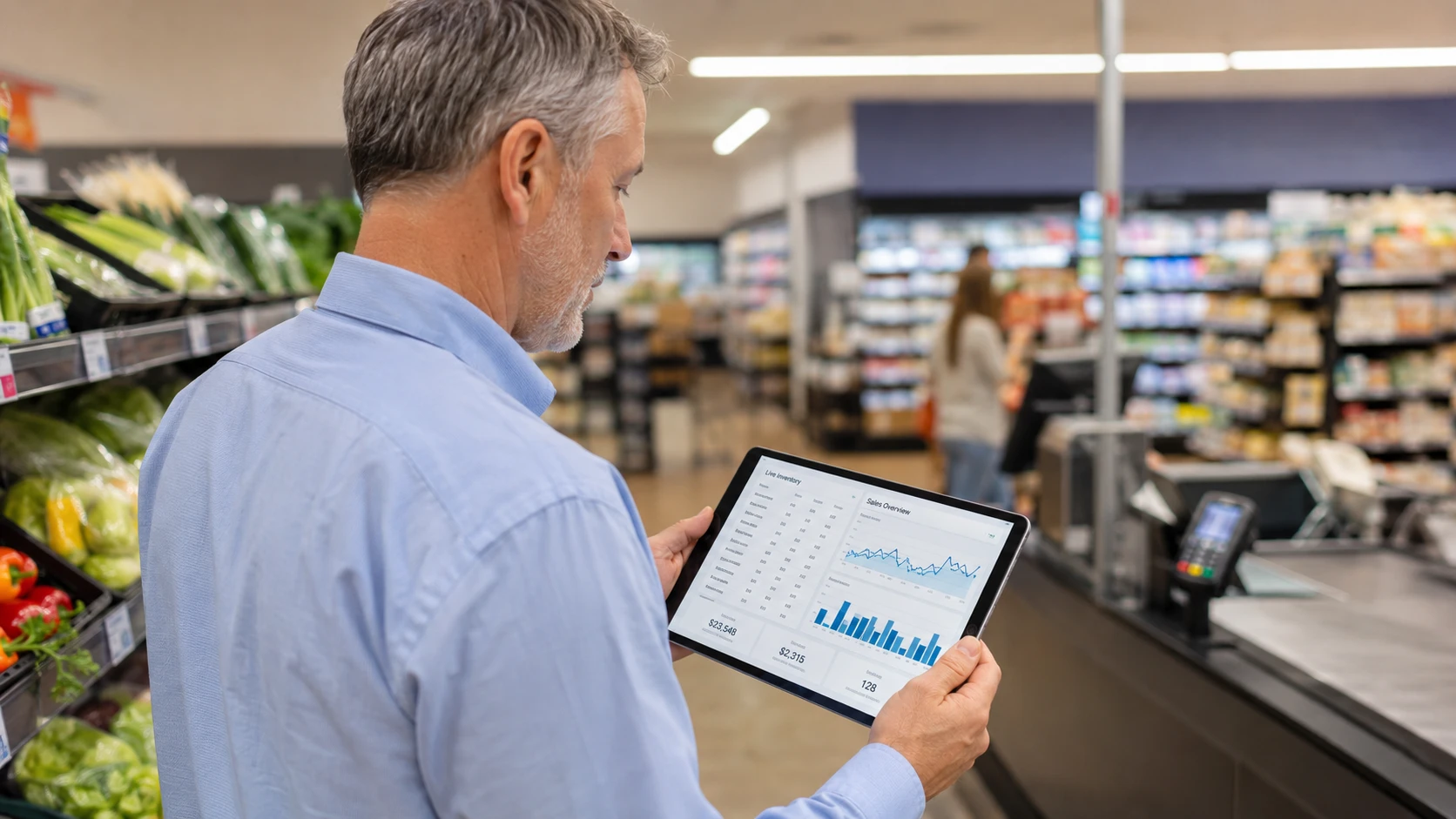
When your POS system can’t talk to your inventory software, your accounting platform, or your supplier ordering system, you’re running your store without full visibility. Every sale creates a manual task somewhere else. Every stocktake is a scramble.
An integrated pos system solves this by connecting every layer of your retail operation into one platform. Sales data flows straight to inventory. Inventory triggers reorders. Accounts update automatically.
By the time the customer walks out the door, your back office already knows exactly what happened.
Key Takeaways
- An integrated POS system shares live data across sales, stock, and accounting with no manual entry
- Real-time inventory visibility reduces stockouts, overordering, and shrinkage
- Back-office reporting becomes automatic rather than a manual end-of-day task
- Multi-site retailers can manage every location from a single, central dashboard
- Australian retail generates nearly $38 billion in monthly sales (ABS, June 2025) for independent stores, even small efficiency gains compound into thousands of dollars saved annually
What Does an Integrated POS System Actually Do?
Australian retail totals nearly $38 billion in monthly turnover according to the Australian Bureau of Statistics (June 2025), putting operational efficiency at the centre of every store’s competitive strategy. An integrated retail pos system is far more than a till. It’s the central hub that links your checkout, inventory management, supplier ordering, accounting, and business reporting into a single, connected platform.
When a customer pays at the register, that transaction automatically updates your stock levels, feeds into your profit-and-loss data, and records against the customer’s account if you run a loyalty scheme. Without integration, each of those actions happens in a separate system, or relies on someone manually keying data across platforms. The more systems you run in silos, the more time your team spends on admin that adds no value.
Merlin™, built by GPK Group specifically for independent Australian retailers, covers Point of Sale, Accounting, Stock and Inventory, Multi-site Management, and Supplier Rebates from a single platform. It’s fully redundant, meaning it keeps processing sales even if your internet drops. Explore the full set of capabilities on GPK’s retail IT solutions page.
“When your checkout data flows directly into your accounting module and your stock on hand updates in real time, you stop running on yesterday’s numbers. That shift from reactive to real-time management is what integrated retail IT actually delivers.”
How POS Integration Connects Your Back Office
The back office is where your store’s profitability actually lives. Margin analysis, stock valuations, supplier rebate calculations, wage cost ratios, none of this is visible in real time if your checkout system is separate from your accounting and inventory software.
With a properly integrated system, daily sales automatically post to your accounts. Stock on hand updates at the point of every transaction. Supplier rebate entitlements accumulate automatically rather than being tallied in a spreadsheet at quarter end. By the time you sit down to review your numbers, the data is already there.
Inventory discrepancies between your checkout and stock records directly impact margins – and they’re often invisible until stocktake time. An integrated system eliminates that gap by keeping your front-of-store and back-office data in sync throughout the trading day. That’s the kind of visibility that helps you act on margin issues before they compound.
“Supplier rebate tracking alone is worth significant money for independent grocers. When your system captures every entitlement automatically rather than relying on manual reconciliation, you’re not leaving money on the table at every supplier invoice cycle.”
Key Operational Areas That Improve With Integration
Here’s a practical comparison of how integration changes day-to-day operations across five areas that affect every independent retailer:
| Operational Area | Without Integration | With Integration |
|---|---|---|
| Inventory management | Manual stocktakes, delayed updates | Real-time on-hand quantities at point of sale |
| Accounting | Manual journal entries, reconciliation backlogs | Automated sales posting, live profit-and-loss |
| Supplier ordering | Separate system, manual reorder calculations | Integrated reorder triggers and rebate tracking |
| Reporting | Data exported and compiled across platforms | Single dashboard across all locations |
| Cybersecurity | Disparate systems with multiple access points | Centralised access controls, fewer vulnerabilities |
Each of these improvements builds on the others. Less time reconciling means more time analysing your numbers. Better stock data means fewer markdowns and missed reorders. Automatic rebate tracking means you capture entitlements your current process might be missing.
What to Look for in a Retail IT Solution
Not every retail IT solution is built with independent retailers in mind. Many are enterprise platforms designed for national chains, carrying complexity and cost that don’t suit a single-store or small multi-site operation. When you’re evaluating options, these are the capabilities that matter most:
- Full redundancy: Your store can’t afford to stop trading because of an internet outage. Look for a system that operates locally and syncs when connectivity is restored.
- Australian support: A helpdesk that understands the retail environment, operates in your timezone, and can provide on-site support when needed.
- Scalability: Whether you’re running one store or ten, the platform should scale without requiring a new system at every growth stage.
- Supplier integration: Direct connections to your distributor’s ordering systems eliminate double handling of purchase orders and missed supplier rebates.
- Security by design: Integrated systems with built-in access controls, audit trails, and centralised monitoring are far less vulnerable than a patchwork of disconnected tools.
GPK Group has supported independent Australian retailers for more than 30 years, with a development team that includes former supermarket and retail POS specialists.
For more on how cybersecurity fits into a connected retail IT stack, see our article on retail data breach examples and how cybersecurity can prevent them. Or read our roundup of the top 5 must-have managed IT services for a broader view of what a fully managed IT environment looks like.
Frequently Asked Questions
A POS (point of sale) system processes transactions at the checkout. A retail management system integrates POS with inventory, accounting, supplier ordering, and reporting. An integrated pos system does both – it handles the sale and ensures data flows automatically to every other part of your operation without manual input.
Implementation timelines vary depending on store size, the number of locations, and how much data needs migrating from your current system. GPK Group manages the entire process, from hardware supply and store fitout through to staff training and ongoing Australian-based support. Most independent retailers are operational on Merlin™ within a structured onboarding period.
We provide managed IT retail support that takes care of your entire IT suite. From optimising your network to sourcing and rolling out your hardware, and with proactive IT support, we manage it all for you. You focus on running your store, and we take care of the tech.
Yes. A well-designed integrated system consolidates data from every location into a single dashboard, giving you visibility across your entire operation in real time. Merlin™ is built specifically for multi-site independent retail, including supermarkets and grocery chains with locations across different states.
Ready to Integrate Your Retail Operations?
GPK Group offers a free, no-obligation strategy call to help you understand exactly where your current system is costing you time and margin. Contact the team or explore our retail IT solutions to see what a connected system looks like for your store.